Cleared OPRA? Here's What Comes Next
A simple guide to the next steps after OPRA; from English tests and AHPRA registration to PR in Australia.
Radhika R Krishnan
7/22/20262 min read
Many Students Keep Asking Me This…
What Happens After Clearing OPRA and How Does PR Really Work?
One of the most common questions I receive from students is: “After clearing OPRA, can I directly get PR in Australia?”
The short answer is no—but understanding the pathway early can significantly improve your chances.
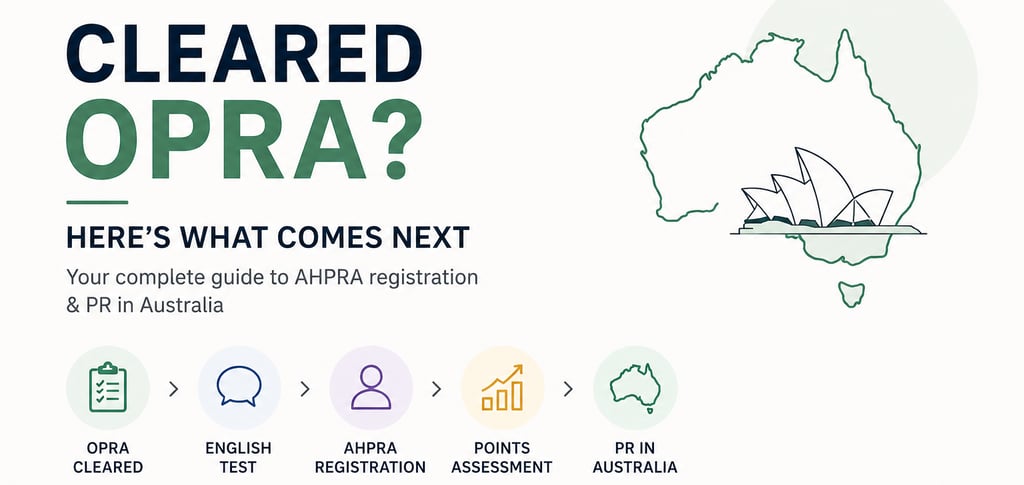
After clearing OPRA, the next major requirement is your English proficiency test. Depending on your pathway, this could be OET, PTE, or IELTS.
If your goal is permanent residency (PR), I always recommend aiming for the highest score possible. The more points you earn, the better your chances of receiving a PR invitation. Once you have completed your English requirements, the next step is obtaining your AHPRA registration.
Many students are surprised to learn that Australia's PR system is based on a points structure.
Your age, work experience, marital status, English score, qualifications, and several other factors contribute to your total points.
For example:
• Age plays a very important role. Up to the age of 32, you can receive the maximum age points. After 32 years of age, you start losing points, and by 45 years of age, age points are no longer awarded.
• The minimum score generally required to be eligible for skilled migration is 65 points. However, meeting 65 points does not guarantee an invitation. The higher your score, the stronger your chances of receiving one.
• Marital status can also affect your score.
• In many cases, if your spouse completes an English examination and achieves the required score, additional points may be available.
One of the biggest misconceptions I hear is that applying for PR requires spending huge amounts of money. In reality, the process can often be completed with a reasonable budget if planned correctly and if you work with a trustworthy migration agency.
I always advise students to focus on finding reliable and ethical consultants rather than simply choosing the cheapest or most advertised option. The good news is that many pharmacists who started their journey with OPRA have successfully navigated the PR process. Some completed much of the process independently, while others sought professional guidance.
Today, many of them are living and working in Australia as permanent residents. Visa pathways such as the 190 and 491 visas are among the options that can lead towards permanent residency, depending on your eligibility and circumstances.
I wanted to share this because many students know about OPRA, but they are often unsure about what comes next. Understanding the pathway helps you make informed decisions and plan your career with confidence.
Remember, clearing OPRA is not the end of the journey—it is the beginning of a new chapter.
© 2025. All rights reserved.
Address
2/184/A Near Vazhakala Junction, Kakkanad, Kochi - 682021
Contacts
+91 98469118888
admin@mypharmville.com
Subscribe to our newsletter
Who We Are
We are the #1 overseas pharmacy coaching institute in Kochi, offering a wide range of courses and visa assistance as well.